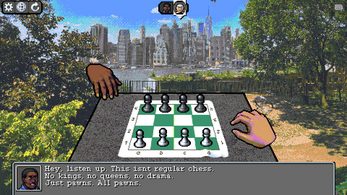
The Rulehouse game starts with a familiar invitation: look at a chessboard and work out your next move. The interesting part is deciding how much of that familiarity you can trust. A rule that seemed obvious a moment ago may be the very thing you need to reconsider. If you enjoy puzzles that ask you to notice an exception, this is a good game to put on your list.
This guide offers a spoiler-light way to approach its boards, along with the published controls and a link to the original demo. The suggestions below are editorial advice, rather than a record of a completed playthrough or a guaranteed solution for every level.
What is the Rulehouse game?
Dalichrome describes Rulehouse as a chess adventure with fifteen levels, changing rules, different settings, and characters. The creator's itch.io page provides the browser demo and a Windows download. That page is the source for the game facts here; the reasoning methods in this guide are our suggestions for getting started.
The appeal of that premise is how it changes your relationship with a board. Ordinary chess knowledge gives you a starting vocabulary, but a puzzle with an unusual rule rewards curiosity as much as recognition. Instead of asking only whether a move would be strong in chess, ask whether it makes sense under the instructions currently in front of you.
Think of each board as a small argument. The layout provides evidence, the rules set the boundaries, and your moves test a possible answer. You can enjoy that process without treating the session as a test of your chess rating.
Read the board before choosing an opening
Begin by finding the immediate objective. Do not automatically assume that a familiar-looking position calls for a familiar winning plan. Read any level text, inspect the pieces you have been given, and identify the detail that distinguishes this situation from the previous one.
A useful first question is: what action would the new rule make possible? A second is: what action would it make dangerous? Those questions keep your attention on the current puzzle. They also prevent a common reasoning error: noticing an unusual feature, then continuing with the same plan you would have used without it.
Before committing to a sequence, describe the board in one plain sentence. For example, your private note might be, "I need to protect this route while finding a different way through." That is a thinking aid, not a description of a particular level. If you cannot yet explain what matters, spend another moment looking rather than making a speculative opening.
Mouse controls and restarting
The published controls are straightforward:
- Left-click to move pieces and use interface buttons.
- Right-click to return pieces or cancel a premove.
- Press R or click the mouse wheel to refresh the level.
Keep your first interactions deliberate. Select something, watch what the interface shows, and then decide whether to continue. A clear separation between selecting and committing makes it easier to notice a misunderstanding before it becomes part of a longer sequence.
Restarting can be useful when you have a specific experiment in mind. Before refreshing, name the assumption you want to test. "This time I will inspect the other response" gives you a purpose; repeating the same opening without a new question usually teaches less.
Build a plan around the unusual rule
Our suggested approach is to work backward from the objective. Identify a position that would satisfy it, then ask what must happen immediately before that position becomes possible. You do not need to calculate a whole game. Even a short chain of necessary conditions can make a crowded board easier to read.
Next, compare two candidate moves. One might preserve flexibility; the other might create a direct threat. Describe the benefit of each and the response you are worried about. If both moves feel equally promising, look for the one that tests your most uncertain assumption while leaving you more options afterward.
Avoid evaluating a piece only by its usual chess reputation. In a rule-changing puzzle, usefulness depends on the local situation. A piece that appears modest may provide the exact interaction you need. Conversely, an impressive-looking move may solve a problem the level never asked you to solve.
This method also helps when you feel overwhelmed: reduce the board to one relationship at a time. Which piece enables your next step? Which opposing option interrupts it? Which square or route connects the two? You are looking for a workable explanation, not trying to memorize every possibility at once.
Turn an unsuccessful attempt into information
When a plan fails, separate the decision from the result. Was the idea wrong, or did you overlook a condition required to make it work? Those are different problems. A wrong idea needs a new approach; an overlooked condition may only need a change in move order.
Write down the earliest point at which reality diverged from your expectation. If you expected one response and saw another, examine that response before resetting. If you thought an interaction was legal and it was not, return to the relevant instruction. Keeping the question small is more productive than concluding that the whole board is impossible.
Change one important choice on the next attempt. Changing everything makes it difficult to tell why the outcome improved or worsened. Keeping most of your sequence stable lets you compare alternatives and gradually build a reliable picture of the position.
Finally, distinguish a rule question from an input problem. An unexpected selection, a missed click, and a surprising piece interaction call for different checks. That simple distinction can save you from inventing an elaborate strategy to explain a basic control mistake.
Enjoy the puzzle without rushing toward spoilers
A full solution can answer a board while leaving the interesting reasoning unexplained. Before seeking one, try asking for a smaller hint: which instruction deserves another look, which relationship matters, or where your current plan first breaks down. That gives you room to finish the discovery yourself.
If you do watch a walkthrough, pause before the decisive move and explain why it might help. Afterwards, try to reconstruct the idea rather than copying a sequence from memory. This turns outside help into a lesson you can carry to another board.
When sharing the game with a friend, describe the premise before describing a solution. "The rules keep changing" communicates the attraction without revealing the surprise. If they want help, ask where their reasoning becomes uncertain and offer a hint at that point.
Who might enjoy Rulehouse?
Consider it if you like compact logical problems, unusual board-game ideas, or the feeling of finding a loophole that was visible all along. The changing-rule premise makes it especially interesting for someone who enjoys revising a theory rather than applying one fixed strategy repeatedly.
It may be a less natural choice if you are looking specifically for standard chess practice. For that purpose, you would normally want stable rules and positions that transfer directly to conventional play. Here, the attraction is reconsidering the rulebook.
For another thoughtful board-game option, see our Rithmomachia guide. Choose it when arithmetic relationships sound more appealing than the surprise of a new local rule.
Browser play and sensible expectations
Use the play link above to open the creator's page. This listing points to the original game rather than hosting a duplicate. Check the source for current version information if a screenshot, instruction, or menu looks different from what you expected.
Our practical recommendation is a desktop or laptop with a mouse, since it makes the published interactions easy to follow. This is a recommendation about controls, not a promise that every browser or device will work equally well. If the game does not respond, check that its window has focus before drawing conclusions about a move.
Frequently asked questions
Is the Rulehouse game free?
The browser demo is available to play on itch.io. Check the original page for current download and pricing options, especially if you want a build other than the browser version.
Do I need to be good at chess?
Knowing conventional pieces may help you recognize the starting point, but our advice is to read each board on its own terms. Treat uncertainty as part of the puzzle rather than evidence that you need to study openings first.
Does this guide give away the solutions?
No level-by-level solutions are included. The examples describe ways to reason about a board, so you can use the guide before playing without being handed a move sequence.
What should I try when I get stuck?
Restate the objective, identify your least certain assumption, and test one alternative. A purposeful restart is often more useful than a long sequence of guesses built on an instruction you have not fully understood.
Where should I check for updates?
Visit Dalichrome's original page and development posts. That is also the appropriate place to look for version-specific information or report a reproducible game issue.
The best reason to try the Rulehouse game is the invitation to think differently about something familiar. Give the board a careful look, let the local rule guide your plan, and keep a little room for surprise.