The Rithmomachia game asks you to look at a board twice: once for position, and once for the numerical relationships hiding in that position. A piece is not just something that occupies a square. Its number can connect it to other pieces in ways that make an apparently quiet arrangement worth examining.
This page introduces the idea behind toniferr's browser edition and offers a manageable way to learn it. The game facts are attributed to the creator, while the examples and study habits are our editorial suggestions. The arithmetic examples illustrate relationships; they are not claims that a particular move is legal in every board position.
What is the Rithmomachia game?
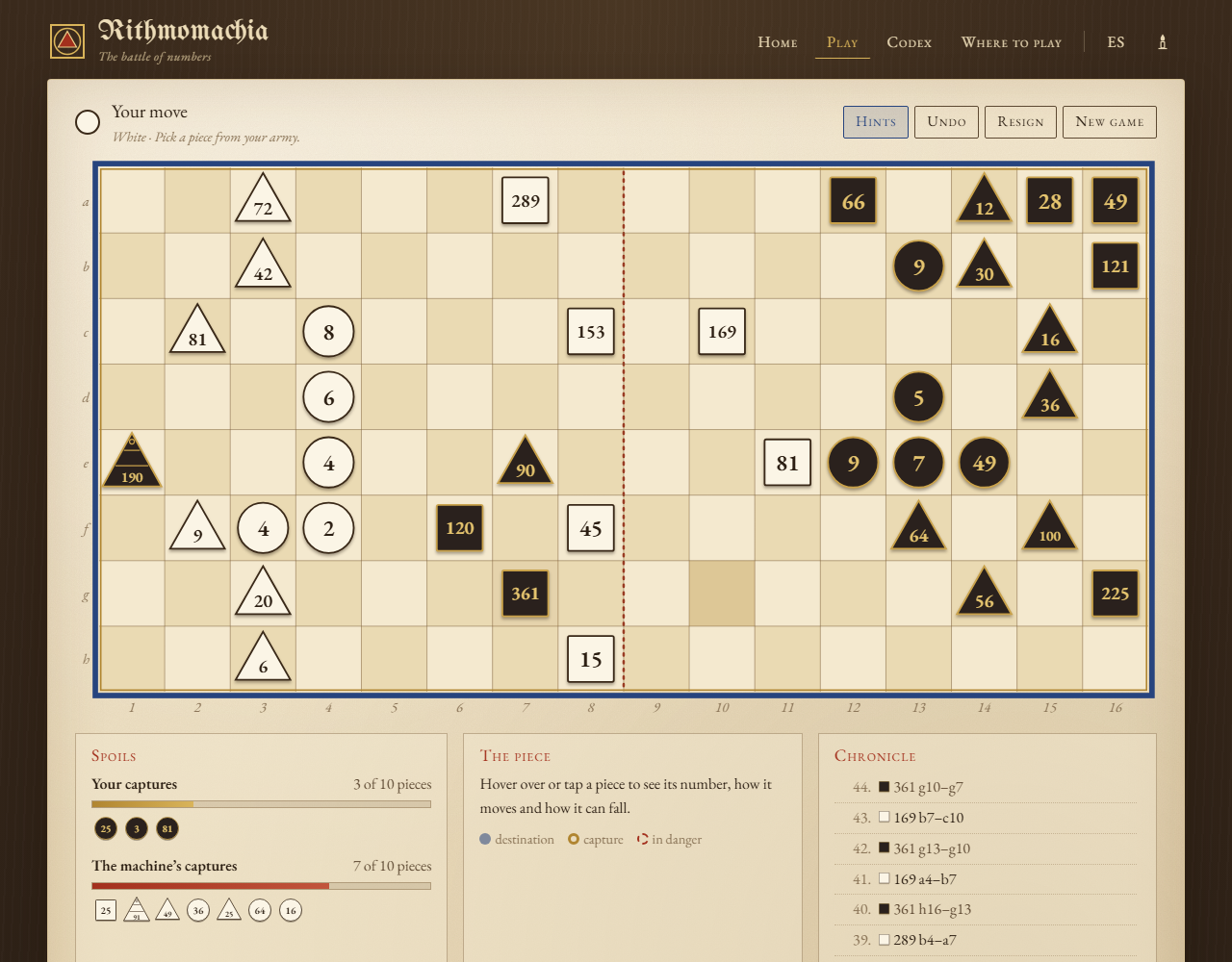
toniferr's itch.io page presents a free browser adaptation of the numbered strategy board game. Each army has twenty-four pieces, with the sides identified as Even and Odd. This edition includes an illustrated rules codex, three AI difficulty levels, and English and Spanish options.
You need to understand what a piece can do in its location, then consider how its value relates to the surrounding values.
Our recommendation is to approach it as a new board game rather than trying to map every feature onto chess. Familiar strategic habits may still help, but the numbers deserve their own attention. A small piece value can be relevant to a relationship that a larger value does not satisfy.
Start with the illustrated codex
Read enough of the in-game codex to understand the basic turn structure, movement, and capture conditions before trying to plan a long sequence. The objective is not to memorize every page at once. It is to know which rule you need to consult when a particular question comes up.
Keep a short distinction in mind: movement tells you how a position can change; capture tells you when an opposing piece can be removed. If you blur those together, you may overlook a valid idea or expect an action the rules do not allow.
When reading an example in the codex, explain the important condition in your own words. What must be aligned? Which values matter? What is the distance condition, if any? Being able to answer a specific question is a more useful learning goal than recognizing a rule's name on the page.
Understand the arithmetic capture ideas
The creator identifies encounter, ambush, assault, and siege as capture methods. Encounter uses equal values; ambush uses a sum; assault connects a piece's value with the number of empty intervening spaces through multiplication. Captures do not work simply by landing on an opponent. Consult the codex for the required positions and the details of siege.
Here is an arithmetic illustration of why the numbers matter. Three plus five equals eight, so those values have a useful sum relationship. Four multiplied by three equals twelve, so those numbers have a multiplication relationship. These calculations show the idea only: they do not establish legal captures without the corresponding placement and rule conditions.
That distinction is worth preserving throughout a session. First find an interesting numerical relationship. Then verify whether the board actually supports it. Finally, consider whether acting on it improves your situation. A correct calculation can be strategically unhelpful, and a promising plan can still depend on a condition you have missed.
Look for relationships before chasing large numbers
Our beginner's suggestion is to scan for easy relationships first. Equal values are quick to notice. Small sums are easy to check. Simple products are easier to hold in mind than several unrelated calculations at once. Starting there makes the position less intimidating.
Do not assign a piece importance solely because its printed value looks impressive. Ask which relationship it contributes to and whether that relationship is available in the current position. A number is useful in context; treating it as a conventional power rating can hide the reason it matters.
Try grouping candidate ideas by purpose. One may threaten an opposing piece, another may improve your own coordination, and another may remove an immediate problem. This gives you something more meaningful to compare than a list of calculations.
For a first game, choose one promising relationship and understand it thoroughly. A clear explanation of a small idea is more valuable than a broad scan that leaves you unsure which conditions were actually satisfied.
Separate calculation from placement
Before pursuing an arithmetic idea, inspect the space between the relevant pieces. Count deliberately and use the codex's definition of distance. Do not assume that the way you count a path in another game transfers to this one.
Then imagine the position after your proposed move. Does the relationship still exist? Has an intervening square changed? Have you moved something that was supporting a different idea? These are planning questions, not additional rules. They help you avoid evaluating the position you started with instead of the position you are about to create.
If an expected capture is unavailable, work through the conditions separately. Check the values, then the arrangement, then the applicable rule. That is more useful than repeatedly selecting the same pieces and hoping the interface will behave differently.
This habit also makes mistakes easier to explain. "My arithmetic was right, but I counted the relevant space incorrectly" identifies a concrete lesson. "The game did something strange" leaves you with no obvious adjustment for the next turn.
A small practice exercise for your first session
Choose a limited part of the board and identify one candidate relationship. Write down the values involved, the rule you think applies, and the condition you still need to confirm. Keep the note short enough that it supports observation rather than taking over the session.
Next, look from the other side's perspective. Which of your own pieces might be involved in a similar relationship? You are not trying to calculate the entire reply tree. You are checking whether your attractive idea has distracted you from an immediate vulnerability.
After a turn, compare what changed with what you expected. If the idea worked, explain why it worked. If it did not, find the earliest wrong assumption. Either result can improve your understanding when you connect it to a specific condition.
Once that process feels comfortable, widen the area you inspect. You do not need every piece to make sense immediately.
Build a plan that survives an answer
An appealing calculation is only the beginning of a strategy. Ask what the opponent can do after you commit. Could the relevant arrangement change? Would you still have a useful follow-up? Does your plan depend on one response that the opponent has no reason to choose?
Compare an immediate opportunity with a move that improves your options. Sometimes your preference will be the direct action; sometimes you may want a position with several possible relationships. Our advice is to explain the tradeoff rather than deciding from the size of a number alone.
Look for cooperation among your own pieces, but check whether that cooperation is fragile. If one moved piece would make the whole idea disappear, the plan deserves extra scrutiny. Having a second purpose for a move can make it easier to adapt when the board changes.
Avoid treating patience as inactivity. A useful preparatory move should make a later decision clearer or address a current concern. If you cannot explain what it improves, return to the board and identify the question you are trying to answer.
Use AI difficulty as a learning choice
For a first session, select a level that leaves you willing to experiment. A difficult opponent may expose weaknesses, but it can also make it harder to distinguish a misunderstood rule from an incomplete plan.
Repeat a level while your main goal is learning the capture conditions. Increase the challenge when you can describe why your choices worked or failed. That gives you a meaningful measure of progress without needing to infer how the AI is implemented.
Who might enjoy this edition?
Consider it if you enjoy board games, arithmetic puzzles, or slowly understanding an unfamiliar system.
If you want a board puzzle with a more immediately recognizable starting point, explore Rulehouse. If you would prefer hands-on movement between thoughtful decisions, try Alpine. Neither comparison is a difficulty ranking; they describe different ways to spend your attention.
Frequently asked questions
Where can I play Rithmomachia?
Follow the play link to the creator's original itch.io page. This guide covers that edition, so its illustrated codex should be your reference if another explanation uses different conventions.
Do I need advanced mathematics?
Start by checking the arithmetic relationships and learning the positional conditions. Our suggestion is to focus on careful counting and clear reasoning rather than treating the board as a test of mathematical speed.
Can I play offline?
The creator states that the game can work offline after loading. An initial connection is still needed; this guide does not verify reloads, browser caching, or progress storage on every device.
Is a phone a good choice?
Touch compatibility has not been verified here. A larger display is our practical recommendation for reading values and comparing positions comfortably.
The Rithmomachia game is worth approaching with curiosity and a small first goal. Learn one capture idea, check its placement conditions, and let each clear relationship make the next part of the board easier to understand.